Showing posts with label *21st Century. Show all posts

Saturday, 30 December 2023

My Favourite History Stamps of 2022 and 2023 + An Outlook of 2024

"Do you know that feeling that whenever you want to devote your time to a specific theme there are already multiple other themes that are at least as interesting?"

I had written down this sentence a year ago on 30th December 2022. Back I then I was planning to write a blog post called Looking Back and Looking Forward - 2022 and 2023 like I had done the year before for 2021 and 2022. I had structured the post, included pictures, but never came around to actually write it. Now a year has passed without any activity here on the blog (or on my main blog for that matter) and I was actually intending to write a post for 2023 and 2024. What however should happen to the things I have written down in 2022? I have now decided to at least show you my favourite history stamps of 2022 and include those of 2023 plus some outlook for 2024 below them. Thus there is leastwise a single post for 2023 on this blog. 

So without further ado these were my favourite stamps about historic themes issued in 2022.

9. Leaders of the Lithuanian Anti-Soviet Resistance (Lithuania)
These two stamps show Romas Kalanta and the Priests of Vilkaviškis. Citing Wikipedia, "Romas Kalanta (22 February 1953 – 14 May 1972) was a 19-year-old Lithuanian high school student who killed himself by self-immolation in an act of protest against the Soviet regime in Lithuania. His death provoked the largest post-war riots in Lithuania and inspired similar self-immolations." The contrast of the coulourful stamp and the fact that the man killed himself by setting himself on fire strikes me as an interesting design choice. 


8. Underwater Archaeology (France)
This stamp is a beautiful remainder of how many magnificient historic items might still be found in the oceans. 


7. 150th birthday of Alexander Roda Roda (Austria)
Alexander Roda Roda was an Austrian writer and satirist born in 1872. Since 1911 he was writing articles for the Neue Freie Presse, one of Austria's most respected newspapers, and especially during World War I produced over 700 articles as war correspondent for the paper. He also contributed to the German satirical magazine Simplicissimus and in the 1920s his humorous and satirical book publications were largely successful. He lived in Germany when the Nazis seized power in 1933, which forced him to move to Graz, which again he left after the Anschluss in 1938 for Switzerland and later the USA. Alexander Roda Roda died in New York in 1945. I included this sheet, because last year I had read the book Februar 33 by Uwe Wittstock, which chronicles the lives of different literary figures during the first month of Adolf Hitler's rule in 1933.


6. 20 years Introduction of the Euro (Portugal)
In 2002 the Euro was introduced as common currency in different European countries. Unfortunately the 20th anniversary was not really commemorated on stamps making these stunning stamps from Portugal even more special. The coins on the stamps are embossed and metallic.


5. Centenary of the Territoire de Belfort (France)
During the Franco-Prussian War of 1870/71 the city of Belfort offered fierce resistance to the German troops. To honour their resistance the city was not annexed by the newly formed German Empire like the rest of Alsace, but remained with France. The monumental Lion of Belfort was created in 1880 by Frédéric Auguste Bartholdi, the sculptor of the Statue of Liberty. Anything connected to the Franco-Prussian War deserves to be included on this list in honour of my master thesis.


4. 900th birthday of Emperor Barbarossa (Austria)
The stamp commemorates a jubilee which I would have liked to see on a German stamp as well. Shown here is the famous Cappenberg Head, a reliquary of John the Evangelist. For a long time it was believed that this sculpture shows the Emperor, as it was a present to his godfather, researches however have shown that this is not true. I have seen it twice in Magdeburg 2021 and Münster 2023. 


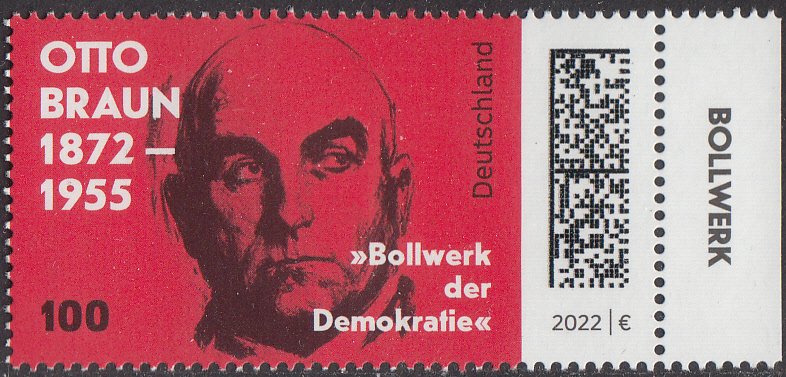
3. 150th Birthday of Otto Braun (Germany)
Otto Braun was a Social Democratic politician and Minister President of Prussia during the time of the Weimar Republic. He reorganised Prussia along democratic lines, thus turning it into the "Rampart of Democracy" in Weimar's turbulent years. In 1932 however he was ousted from power in the Prussian coup d'état (Preußenschlag) by Reich Chancellor Franz von Papen. I really like the design of this stamp resembling an old election poster and I am always happy to see stamps about the Weimar Republic.

2. Centenary of the Discovery of the Tomb of Tutankhamun (France)
I really like to see Egyptian antiquities. Actually I wanted to use the jubilee of Tutankhamun to dive deeper into Egyptian history, but other things prevented me from doing so. For some reason I am delaying it as much as the opening of the Grand Egyptian Museum. This French stamp is printed with gold foil. 


1. 450th anniversary of the Herzog August Library in Wolfenbüttel (Germany)
The Herzog August Library was founded by Duke Julius of Brunswick-Lüneburg in 1572. It houses a large collection of manuscripts of the Middle Ages and the Early Modern Period and is one of the oldest libraries in the World which have never suffered loss to its collection. Its most famous librarians were Gottfried Wilhelm Leibniz and Gotthold Ephraim Lessing. Today it is a major international research centre for Medieval and Early Modern culture. Some of its rooms are used as museum. Among the most important and famous manuscripts of the library are the Gospels of Henry the Lion, a copy of the Sachsenspiegel, a printed edition of the Latin Psalter with annotations by Martin Luther, Luther's German translation of the New Testament and parts of the Bibliotheca Corviniana Collection. The latter three are even part of the Memory of the World Programme of the UNESCO. How could I not put this wonderful stamp about a regional anniversary on the first spot for 2022?


Due to external circumstances my collection had to lie still for a big part of the year. Nonetheless I still get some amazing stamps, so after the nine issues of 2022 let's get right to the ten issues of 2023. 

10. Centenary of Bambi (Austria) 
Bambi is probably best (only?) known due to the 1942 Disney movie. However the young deer first appeared in a book by Felix Salten in 1922, which was used as the basis of the movie. On a sad note, the government of Nazi Germany banned the book in 1936 as "political allegory on the treatment of Jews in Europe." Many copies of the novel were burned.


9. Max Oppenheimer (Austria)
Max Oppenheimer was an Austrian artist, however this stamp is not on the list due to him. Way more I included it due to the depicted woman in the artwork: Tilla Durieux was an Austrian actress. She played a minor role in Fritz Lang's 1929 science fiction silent film Woman in the Moon, which played a role in my state examination this year.


8. Alphonse Mucha (France)
After the hard years of Covid-19 the museums are finally back on track. This year I hence visited some wonderful special exhibitions including Dürer in Berlin, Machine Room of the Gods and Renaissance in the North in Frankfurt am Main, Benin Bronzes in Hamburg, Otto the Great in Magdeburg, Venetian art in Munich, Barbarossa in Münster and Fischer von Erlach in Salzburg. One of favourites was Goddesses of Art Nouveau in Braunschweig. Of course also Mucha was thematised in the exhibition. 


7. Stralsund Letter (Germany)
One of the big jubilees of 2023 was the 175th anniversary of the Revolution of 1848. Once again however there was no stamp to honour an important event in Germany's  history. As some type of mockery or probably more due to historic ignorance this stamp about the Stralsund Letter was issued in the series Treasures of Philately. The stamps used on this historic piece show Frederick William IV of Prussia, the king who crushed the revolution. I just had to get this stamp together with a special postmark about the revolution. 


6. Wreck of a Hanseatic Ship (Estonia)
Following my post about the Hanseatic League I am always happy to have a new stamp. This one I bought during the IBRA in Essen. 


5. 400 years First Calculating Machine (Germany)
Wilhelm Schickard, a friend of Johannes Kepler, created the first Calculating Machine in 1623. The original one is long lost, but it was possible to reconstruct it due to an image in a letter sent by Schickard to Kepler. As a mathematician and historian this stamp was supposed to be higher on my list, but went down due to its ugly design. 


4. 100th Death Anniversary of Gustave Eiffel (France)
For the creator of its most famous landmark France issued this beautiful souvenir sheet. Not sure why, but I just like it.


3. 150th anniversary of the 1873 Vienna World's Fair (Austria)
The World's Fair in Vienna was just the fifth event of its kind and the first in the German-speaking World. It was held to commemorate the 25th throne jubilee of Emperor Franz Joseph and was a way to show the new confidence of the Austro-Hungarian Empire after the lost war against Prussia in 1866. It must have been a magnificient event to visit. 


2. Orient Express (France)
The Orient Express is a symbol of the elegant travelling by train and one of the great train journeys in the World. This souvenir sheet perfectly captures the spirit of the time. Regarding design aspects this might be in my opinion the most beautiful stamp issue of the year. 


1. 550th Birthday of Nicolaus Copernicus (Poland and Vatican)
Copernicus was one of the most influential persons in European history. Although he might not be the first to formulate such a model, he is connected with the heliocentric worldview, which places the sun in the centre of the universe rather than the Earth. The publication of the model in his book De revolutionibus orbium coelestium, just before his death in 1543, was a major event in the history of science, triggering the Copernican Revolution and making a pioneering contribution to the Scientific Revolution. A few countries issued stamps for his jubilee, but my favourite is this joint souvenir sheet from Poland and the Vatican. 


So these have been my favourite history stamps of 2022 and 2023, which I have chosen not only due to artistic reasons, but mainly by looking at the themes which left an imprint on me during these years, two years which have been extremely exhausting. Luckily I hope that 2024 will be much calmer, so it is suitably to look forward to what comes next. 

One of the backbones of this blog have been the Big Jubilees, but for the fourth year in a row there seems to be no deserving theme. Looking at stamp programmes the 150th anniversary of the Universal Postal Union will be celebrated by many countries. I am however hesitant to consider it as the Big Jubilee. The themes I have chosen for myself for a deeper involvement are the 100th death anniversaries of Franz Kafka and Lenin, the 125th birthday of Erich Kästner and the 300th birthday of Immanuel Kant. Other interesting jubilees include the 150th anniversary of Impressionism, the 150th birthday of Winston Churchill, the 250th anniversary of the First Continental Congress and Benjamin Jesty's experiments of smallpox inoculations, the 250th birthday of Caspar David Friedrich, the 500th anniversary of the German Peasants' War and the 700th death anniversary of Marco Polo. Will I write blog posts about any of these themes? I hope so, but I doubt it. 

Wishing You all a Happy New Year that will hopefully be filled with learning and collecting!

Sunday, 23 October 2022

The European Heritage Label Sites of 2022, err 2021

I am already very late to the party, but the new European Heritage Label Sites had been announced in late April 2022, whichs of course means these are the sites inscribed in 2021. You get it? The following sites got the label:
  • Vučedol Culture Museum and Archaeological Site (Croatia)
  • Archaeological Site of Nemea (Greece)
  • Thracian Art in Eastern Rhodopes: Aleksandrovo Tomb (Bulgaria)
  • Almadén Mining Park (Spain)
  • Echternach Saint Willibrord Heritage (Luxembourg)
  • Historic Centre of Turaida (Latvia)
  • Medieval wall painting in Gemer and Malohont Regions (Slovakia)
  • The Oderbruch (Germany)
  • Palace of the European Commission of the Danube (Romania)
  • Seminaarinmäki Campus - Equality in Education (Finland)
  • Ventotene (Italy)
  • MigratieMuseumMigration (MMM) (Belgium)
That means that the following pre-selected sites did not get the label:
  • Grand Commandery Alden Biesen, Belgium
  • Fulda and Petersberg – Centers of the Carolingian Education Reform, Germany
  • The Wellspring of Multilingualism - Baška Tablet (Bašćanska ploča) and the Complex of the Church of St Lucy, Croatia
  • Mariapocs National Shrine, Hungary
  • Land of Water, Land in Water. The Po River Delta and Venice, Italy
  • The Address of the Polish Bishops to the German Bishops, November 18, 1965, Poland
  • Lech Hill with Gniezno Cathedral, Poland
  • Lines of Torres Vedras, Portugal
  • ASTRA Museum of Traditional Folk Civilization, Romania
Comparing the final list with those pre-selected sites earlier released and discussed (see here) some names had been changed. For Bulgaria and Slovakia those are the first inscribed sites. The only countries without inscribed sites are now Cyprus, Denmark, Ireland, Malta and Sweden, but if I remember right none of them has ever nominated a site. Like I have said before, some of these new sites are definitely worthy of the site while other seem to be strange selections. That is primarily due to the criteria of the selection which looks more closely at the narrative than the site per se. The Medieval wall painting in Gemer and Malohont Regions and the Oderbruch are for sure interesting sites, but I think that their stated European significance could be illustrated by many other sites as well. On another note many of these sites will be very difficult to collect on cards or stamps. So far I only have cards of Echternach and the Oderbruch plus a stamp about Ventotene. Any help is very welcome. Using the label Eurorpean Heritage Label on the right side you can always see my collection. There you will also find short information about all sites. Let's see which sites will be pre-selected in the next round. Those can be expected in late 2023. 


Grand Commandery Alden Biesen - not inscribed

Echternach Saint Willibrord Heritage - inscribed!

Thursday, 13 January 2022

Looking Back and Looking Forward - 2021 and 2022

2021 has come and gone and I doubt that I will miss it. It was a stressful year and a strange for my personal study of history. In fact I have devoted even more time to history than usual, as a very big part of the year was filled with writing my master thesis. That however means on the other hand that I had very little time for leisure with my stamps, postcards and blogs. My main blog suffered, but this blog suffered even more. Only four posts I have published here, one each in January, March, April and December. I had actually planned many more including two or three bigger posts. Maybe I will write them this year, but I do not think so, as it will be another stressful year and I have already new plans. Apart from these personal reasons for a different year of devoting time to history also the pandemic still plays a role in changing plans especially with regard to museums, which for me are an important part of engaging with history in a leisurely way. Due to Covid-19 museums here in the region were closed on 1st November 2020 and apart from one week in March were just allowed to reopen in late May. Nonetheless I still managed to do roughly 20 museum visits in 2021. The highlights were the Nebra Sky Disc exhibition in Halle an der Saale, the new permanent exhibition at the Bavarian Army Museum in Ingolstadt, "Kinosaurier" in Hanover, the Premonstratensians in Magdeburg, Plagues in Hildesheim and exhibitions about Rudolf Manga Bell and the Silk Road in Hamburg. In my Outlook of 2021 I had written about nine exhibitions that I had hopes to visit during the year. Two of them were postponed and six of them I actually visited. Only the Late Gothic exhibition in Berlin I have not seen. When I wrote that the opening of the Humboldt Forum was not on my radar. I have not visited it yet, but hope to do so this year. 

In my outlook I had already mentioned that there seems to be no big jubilee in 2021 and I was right. I had added some jubiless to my original list and these here the stamp issue numbers I have for them:
  • zero issues: 150 years Proclamation of the German Empire, 500 years Diet of Worms, 650th birthday of Zheng He, 750 years Beginning of Marco Polo's Journey
  • one issue: 100th birthday of Friedrich Dürrenmatt (Switzerland), 100th birthday of Sophie Scholl (Germany), 150th birthday of Friedrich Ebert (Germany), 450th birthday of Johannes Kepler (KEP), 500 years Fuggerei in Augsburg (Germany), 1600 years Venice (Italy), 1700 years Jewish Life in Germany (Germany), 1900th birthday of Marcus Aurelius (Slovakia)
  • two issues: 100th birthday of Joseph Beuys (Germany, Serbia), 100th birthday of Stanislaw Lem (Poland, Serbia), 150th birthday of Marcel Proust (Monaco, Portugal), 200th birthday of Charles Baudelaire (France, Serbia), 200th birthday of Gustave Flaubert (France, Monaco), 200 years Beginning of the Greek Revolution (Cyprus, Greece), 300 years End of the Great Northern War (Åland Islands, Russia)
  • three issues: 450 years Battle of Lepanto (Italy, Montenegro, Spain)
  • four issues: 450th birthday of Caravaggio (Bulgaria, North Macedonia, San Marino, Vatican), 550th birthday of Albrecht Dürer (Bulgaria, Hungary, KEP, San Marino)
  • five issues: 100 years Communist Party of China (Armenia, China, Hong Kong, Macau, Serbia), 100 years Discovery of Insulin (Brazil, Canada, North Macedonia, Pakistan, Switzerland), 200th death anniversary of Napoleon (Andorra - French Post, France, Italy, Malta, Saint Helena + Cuba (EDIT: 6th February 2022)), 400th birthday of Jean de La Fontaine (Bulgaria, France, Hungary, Monaco, Portugal)
  • six issues: 700th death anniversary of Dante Alighieri (Czechia, Georgia, Italy, Liechtenstein, Uruguay, Vatican)
  • seven issues: 200th birthday of Fyodor Dostoevsky (Bosnia and Herzegovina - Republic Srpska, Bulgaria, KEP, Monaco, North Macedonia, Russia, Serbia)
And just for comparison these are the number for recent BIG jubilees:
  • 16 issues: 100 years End of World War I (2018)
  • 19 issues: 500 years Reformation (2017)
  • 30 issues: 50 years Moon Landing (2019)
  • 40 issues: 250th birthday of Ludwig van Beethoven (2020)
In the outlook I wondered whether Dante or Napoleon might become the BIG jubilee of the year and indeed both performed rather well, but are nothing near the jubilees of the last years. Fyodor Dostoevsky on the other hand was not on my radar at all.


The end of the year also means once again to choose My Favourite History Stamps of the Year in addition to my general My Favourite Stamps of 2021 over on my stamp blog. Unlike last year I am contended with this list, so without further ado:

11. Robert Blum (Germany)
Robert Blum is one of the most famous German proponents of the Revolution of 1848, yet this is the first time that he is shown on a stamp. I actually thought that this might be the "prequel" for a 175th anniversary stamp issue of the revolution itself in 2023, but no such stamp is planned. This souvenir sheet is not connected to any anniversary and is actually part of the stamp series "Aufrechte Demokraten" (Upright Democrats), which was started in 2002, but for which this is just the sixth issue. It is great to see Blum honoured with a stamp, but I do not like this design at all with the white streak on his face and the text in the background that is covered and thus unreadable. Hence just the 11th rank.


10. 400th Birthday of Jean de La Fontaine (France)
I really like the design of this sheet, but more so because I collect also Childhood Heroes on Stamps. La Fontaine was not on my historical radar until recently, his works are however of immense importance and this sheets thus deserves to be included here.


9. Bicentenary of the Congress of Laibach (Slovenia)
This congress in Laibach, which is now called Ljubljana and is Slovenia's capital, was one of four successor congresses of the Congress of Vienna and an "attempt of the five Great Powers to settle international problems after the Napoleonic Wars through discussion and collective weight rather than on the battlefield" (Wikipedia). I guess it is not widely known that these congresses existed at all, but it is nice to see that at least one is remembered on a local/national level. This is a nice little stamp, but unfortunately a victim of my own course of the year. I bought it online, scanned it, put in my album and did not think about it further. Still a worthy addition to any stamp collection about European history.


8. Industrial Revolutions (United Kingdom)
This is a very interesting set. I am not aware of any other issue that decidedly thematises this theme and shows different inventions of the era (although I am actually sure that there are some), so this is a set of immense interest for my collection.


7. Birth Centenary of Sophie Scholl (Germany)
Standing up against extremism is once again of big importance these days and so a list like this would not be complete without Sophie Scholl. It is nice to see that they used a different image than usual and they have chosen an interesting quote: "Such a nice, sunny day and I shall go. What however is my death due to, if through us thousands of people are startled and awaken" (22nd February 1943, Scholl's death day). The question however remains why her brother Hans did not get the same treatment in 2018.


6. 230th anniversary of the Constitution of 3 May 1791 (Poland)
Did you know that Poland (or more precisely the Polish-Lithuanian Commonwealth) was one of the first democratic states in Europa? A democratic constitution was introduced already in 1791, but was not effective very long, as the country was divided soon after and disappeared from the map for over 100 years. A rather odd jubilee, but this constitution got the European Heritage Label. Once again a painting by Jan Matejko was chosen to illustrate a historic theme on a Polish stamp.


5. 1700th anniversary of Jewish Life in Germany (Germany)
This is a striking yet simple design and once again a theme to remember these days. Like the Slovenian stamp this one was issued in early 2021 and I have forgetten it a bit in the course of the year. I guess Covid-19 prevented many bigger celebrations. This stamp is also a reminder for the sad fact that the number of special postmarks in Germany was drastically decreased in 2021. In 2019 there were over 360 special postmarks used in Germany (I mean those that are organised locally and not officially tied to a stamp issue), last year there were only roughly 170. That means a great loss for the philatelic commemoration for smaller and local events and anniversaries. In a normal year I guess there would have been multiple postmarks highlighting local connections to this jubilee, but under these circumstances there was only this one from Seelow. It is nonetheless interesting for showing a Stolperstein, the ubiquitous memorial to the Shoa.


4. Margarete Schütte-Lihotzky and the Frankfurt Kitchen (Austria)
This is another stamp without jubilee, but I like it very much, as it closes a big gap in the philatelic documentation of modern architecture. The Frankfurt Kitchen was designed by Margarete Schütte-Lihotzky, one of the first women to study architecture in the Austro-Hungarian Empire and probably the first who actually worked fully as architect, for Ernst May's social housing project New Frankfurt. It is considered to be the forerunner of the modern fitted kitchen. Schütte-Lihotzky however was not only a designer, but also a communist activist in the Austrian resistance to Nazism. A worthy and long overdue commemoration!


3. Margaret Atwood (Canada)
Do not worry, Margaret Atwood is not dead yet. So you might wonder, why do I include a stamp like this in my list of history stamps? Well the reason is that reading The Handmaid's Tale shaped my interest in historic themes in the recent years like nothing else. Compared to Brave New World, Nineteen Eighty-Four and Fahrenheit 451, I think that this dystopia is the most frightening and also most realistic and in case you did not know, Atwood says that everything that she described in her book had an equivalent in real history. Is that not reason enough to investigate the dark sides of humanity's past from dictatorships to genocides for many years to come? 


2. 150th anniversary of the Internment of the Bourbaki Army (Switzerland)
As I said before, I have written my master thesis this year. The theme was the change of depiction of the Foundation of the German Empire in German history schoolbooks between 1971 and 2021 and the reason why I chose this theme was the omission of a German stamp for the jubilee. 1971 there was a stamp and my assumption was that if back then there was and now there is not a stamp there had to be changes as well in how the schools want to communicate the theme to the following generations. Well, in the books however there is no big change at all and so I am wondering even more why there was no such stamp. Our southwestern neighbour however issued a stamp about an event in the atmosphere of the German Empire's foundation. The French Armée de l'Est originally under General Charles Denis Bourbaki was interned in Switzerland in the late phase of the Franco-Prussian War and Switzerland was thus able to consolidate its reputation as a humanitarian nation. The stamp shows a detail of a panorama painting about this event. Apparently you could scan it with a particular app to view the complete painting, but I have not tried.


Honourable Mention: Konrad Adenauer (Spain)
Last year my first place stamp was the Spanish stamp about Robert Schuman that was said to be the start of a series about the Founding Figures of the European Union and I said that I was looking for the stamp about Konrad Adenauer. That stamp was now already issued, but I do not have it yet, so just a honourable mention.

1. Death Bicentenary of Napoleon Bonaparte (France)
Even if I would have got the Adenauer stamp it would not have stand a chance against this sheet. I think this is one of the most beautiful stamp issues that I have ever seen and talking about history-themed stamps nothing comes near it for me in 2021. A well deserved first place and in fact the only theme I managed to write a post about in 2021, so nothing more to add.


With Looking Back finished, let's now begin the Looking Forward.

2022 will bring us of course the announcement of the new European Heritage Label sites. That is something I always look forward to and it might happen in March. Checking out some museum programs and other online news the biggest German history exhibition of the year seems to happen in Trier. From June to November a state exhibition in three museums will thematise the Fall of the Roman Empire. Other German exhibitions I hope to visit will be held in Hildesheim (Islamic Art in Medieval treasures), Münster (Barbarossa) and maybe Stuttgart (History of Beer and Wine). The National Museum of History and Art in Luxembourg plans an exhibition about the Luxembourgian entanglement with the (Belgian) imperialism, which sounds very enticing. Too far away but still noteworthy are the exhibition about the Nebra Sky Disc at the British Museum in London and the openings of Grand Egyptian Museum in Cairo, the Palace Museum in Hong Kong and the Lucas Museum of Narrative Art in Los Angeles. 

This is my preliminary list of Jubilees in 2022:

50 years The Limits to Growth
75 years Independence of India
100th birthday of Betty White
100th birthday of Doris Day
100th birthday of Kurt Vonnegut
100 years Discovery of the Tomb of Tutankhamun
100 years Irish Free State
100 years Soviet Union
150th birthday of Piet Mondrian
150th birthday of Otto Braun
150th death anniversary of Giuseppe Mazzini
150 years Yellowstone National Park
200th birthday of Gregor Mendel
200th birthday of Heinrich Schliemann
200th birthday of Louis Pasteur
200th death anniversary of Karl August von Hardenberg
200 years Decipherment of the Hieroglyphs
200 years Independence of Brazil
250th birthday of Novalis
250 years First Partition of Poland
350th birthday of Peter the Great
350 years Rampjaar
400th birthday of Molière
450 years Herzog August Library in Wolfenbüttel
450 years Os Lusíadas
450 years Saint Bartholomew's Day Massacre
550th birthday of Lucas Cranach the Elder
900th birthday of Frederick Barbarossa

Once again there is no jubilee that stands out, so most likely there will be again no BIG jubilee. I am however aware of at least one stamp for most of the themes. I would guess that of these either Mendel, Moliere or Pasteur will have the most stamps issued by the end of the year. As this year will be busy, I do not want to plan too much, but I think about posts for Ancient Egypt, Louis Pasteur and maybe Guiseppe Mazzini.


Thursday, 8 April 2021

Pre-selected Sites for the European Heritage Label 2022

Exactly a year ago I wrote here about the new sites that got the European Heritage Label. Today again I can present you some news about the label, as the pre-selected sites for 2022 were announced recently. Let's have a closer look at them:

  • Grand Commandery Alden Biesen, Belgium - one of the largest and most impressive castle estates in Europa, former headquarters of a Grand Commander of the Teutonic Order, oversaw twelve smaller commanderies in the Rhine-Meuse region
  • MigratieMuseumMigration, Belgium - migration museum in Brussels, opened in 2019
  • Museum Center "Thracian Art in the Eastern Rhodopes": the Unknown European Ancestors, Bulgaria - shows a replica of a Thracian tomb dated to the 4th century BCE, the tomb itself is noted for its high artistic value of its frescoes
  • Fulda and Petersberg – Centers of the Carolingian Education Reform, Germany - the name says it all, check out their website for more
  • The Oderbruch | A landscape made by people, Germany - marshland near the German-Polish border, to bring the land under cultivation Frederick the Great ordered its drainage in the 18th century
  • Archaeological Site of Nemea, Greece - known as site of Heracles' fight against the Nemean Lion and the Nemean Games
  • Almadén Mining Park, Spain - production site of the largest quantity of liquid mercury metal in the World, also a UNESCO World Heritage Site
  • Seminaarinmäki Campus – Equality of Education, Finland - oldest campus of the Jyväskylä University, said to be the most beautiful campus in Finland
  • The Wellspring of Multilingualism - Baška Tablet (Bašćanska ploča) and the Complex of the Church of St Lucy, Croatia - one of the oldest monuments containing an inscription in the Croatian language
  • Vučedol Culture Museum and Vučedol Archaeological Site – source of European civilization, Croatia - centre of the eponymous culture, which was contemporary with the Sumer period in Mesopotamia, the Early Dynastic period in Egypt and the earliest settlements of Troy, second application
  • Mariapocs National Shrine, Hungary - important place of pilgrimage
  • Land of Water, Land in Water. The Po River Delta and Venice, Italy - not sure at all what this site will include
  • Ventotene, Italy - island in the Tyrrhenian Sea, site of a Bourbon and later Fascist prison camp, Altiero Spinelli wrote there the Ventotene Manifesto, which promoted the idea of a federal Europa after the war
  • Echternach Saint Willibrord Heritage, Luxembourg - important site of the Early Medieval Christianisation of Europa and the Frisians in particular
  • The Historical Centre of Turaida, Latvia - in 1212 a peace treaty was signed here between the Estonian tribes and the Livonian Brothers of the Sword, the Archbisphoric of Riga, the Livonians and the Latgalians
  • The Address of the Polish Bishops to the German Bishops, November 18, 1965, Poland - invitation sent by Polish bishops to their German counterparts to the 1000 Anniversary Celebrations of Poland's Christianisation, important step in German-Polish reconciliation after World War II
  • Lech Hill with Gniezno Cathedral, Poland - first historical capital of Poland, important site in the history of Christianity in Poland, site of the Congress of Gniezno, royal coronation site
  • Lines of Torres Vedras, Portugal - built to protect Lisbon against the Napoleonic forces, second application
  • ASTRA Museum of Traditional Folk Civilization, Romania - one of the largest open-air museum in Central and Eastern Europa, contains houses and workshops of Romanian folk culture from the pre-industrial era
  • The Palace of the European Commission of the Danube, Romania - housed the European Commission of the Danube until 1921, the commission itself dates back to 1815
  • Medieval wall painting in Gemer and Malohont Regions, Slovakia - medieval wall paintings by Italian frescoers and their masters
Unfortunately again no more information than the name was given yet, so for anything else research has to be done. Like always this is easy for some, but difficult for others, as some names are not very meaningful. As a reminder, this is what is important for the final inscription:

"The goal of the European Heritage Label is to raise awareness of European shared history and to highlight education opportunities. The award strengthens people’s sense of belonging to the European Union’s values and identification with Europe’s cultural heritage. 

Sites which have played a significant role in the history and culture of Europe are eligible for the European Heritage Label award."

Important is also the European narrative of the site and the demonstration of "education oppurtunities". This however means that maybe the site with the most significant role is not inscribed, as noone created the right narrative or highlighted European education oppurtunities. In reverse this also means that nearly everything can be inscribed if an energetic initiave worked out both. In my opinion this leads to the inscription of sites that nobody ever heard of, while important sites of European history and culture will never be inscribed, as the responsible persons there might have never heard of the label. For sure all sites are somehow interesting, but they do not always represent the pinnacle of European history, but only add to the already immense number of sites that have to be considered. 

For me the most interesting of these sites are the Thracian museum in Bulgaria, Fulda and Petersberg, the sites of the Vučedol culture, Ventone, Echternach, Lech Hill and the Lines of Torres Vedras. I am looking forward to see the final inscriptions later on. 

Although some of the sites should be easy to get on cards, so far I only got one from Fulda. However I also have these two philatelic items about the sites.

Prepaid Cover about Fulda

Souvenir Sheet about the 1000th anniversary of the
Congress of Gniezno

Friday, 19 March 2021

Review and Overview of the Beethoven 2020 Stamps

EDIT: Information gathered after I published this post is included in orange.

Like I had promised earlier here is a small overview of the Beethoven stamps that were issued last year.
  • Beethoven stamps were issued in Albania, Argentina, Armenia, Austria, Azerbaijan, Bosnia and Herzegovina, Bosnia and Herzegovina (Post Mostar), Bosnia and Herzegovina (Serb Post), Brazil, Bulgaria, Croatia, Dominican Republic, Faroe Islands, France, Germany, Gibraltar, Guernsey, Hungary, Israel, Jersey, Kazakhstan, KEP, Lebanon, Liechtenstein, Macau, Malta, Mexico, Moldova, Monaco, Mongolia, North Macedonia, Poland, Portugal, Romania, Serbia, Spain, Ukraine, Uruguay, Vatican and Vietnam.
  • So in total 38+2 postal administrations issued stamps about Beethoven for his 250th birth anniversary. 25+1 of them are from Europa, 9 from Asia and 4+1 from the Americas. Also there were a few agency-produced catch penny issues from Africa, but these can be ignored without loss. 
  • There might be more stamps out there. About the issue from Mongolia for example I just learned in February 2021.
  • I am not sure if the stamp from Mexico was issued. The Mexican Post announced it on Instagram, but as of now it is still not included in the Colnect catalogue. Nonetheless for everything written below I have included it. The stamp is still (8th April 2021) not included in the Colnect catalogue, but on Mon Blog Timbré you can see a used version on a cover, so it was definitely issued.
  • Latvia and Slovakia originally also announced Beethoven stamps, but they were apparently cancelled in the course of the year. 
  • The first country with the Beethoven stamp was Germany, where the stamp became available already on 2nd January. As Beethoven was just baptised in December 1770, this stamp was issued nearly a year before the actual anniversary. Apart from the normal gummed stamp there have been also a gummed souvenir sheet and self-adhesive stamps from the coil and a booklet. All however use the same design.

  • Counting all the "different" stamps (so counting Germany as one, but for example a souvenir sheet of four different stamps as four) there are 84+3 of them. 
  • So on average there are two stamps from every country, but in fact just eight+1 of the 38+2 countries issued more than one stamp. Albania, Bosnia and Herzegovina, Portugal, Romania and Vietnam issued two stamps, Guernsey and Uruguay issued four, Jersey issued seven and Lebanon issued a sheet with 20(!) different stamps.
  • Most countries issued sets or single stamps solely dedicated to Beethoven, but Gibraltar, KEP and Moldova all issued one stamp in a bigger set about anniversaries. 
  • Unfortunately many of the stamps are not very creative. 20+1 of the 38+2 postal administrations used the famous portrait of Joseph Karl Stieler on at least one of their stamps. Some countries like the Faroe Islands, Germany and Israel reimagined the portrait, but others like Brazil, Hungary and Portugal just used the plain portrait and added country name, face value and a few other words. Many countries however used completely different images and especially in bigger sets like those from Guernsey and Jersey multiple portraits are used. 
  • 16+1 of the 38+2 postal administrations used the official logo of the jubilee year on their stamps: BTHVN 2020. 

  • As I had already written, Guernsey issued four stamps, but they were not issued at once, but on different dates in the course of the year. This issue format was apparently quite popular, as they are doing the same now of the Royal British Legion this year. When the last stamp was issued, all four became however also available in a combined souvenir sheet. 
  • The stamps from Jersey are advertised as "Award-Winning Stamp Issue", as they "were a winning entry in Communication Arts magazine's 61st annual design competition, a prestigious international competition showcasing the best in visual communications."
  • The issue from Spain takes the form of a vinyl disc and can actually be listened to. It reproduces Symphony No. 5 in C minor, Op. 67 performed by the Madrid Festival Orchestra.
  • You can read a very nice review of the Israeli stamp on the Israel Stamp Review blog (click here).
  • Since the Reformation Jubilee in 2017 I have not tried to collect all the international stamps about any of Big Jubilees, but only got a few selected issues. In my collection for Beethoven I only have the stamps from Austria, France, Germany, Israel, Macau and Portugal, but I still hope to get the ones from Poland and the Vatican later on.
  • Of all the Beethoven stamps issued in 2020 my favourite comes from France. It might not be the best designed issue, but I think it is nicely straight forward and decent and on the other hand also much more creative than others and has a great golden touch. 


This was definitely not the deepest dive into history or philately, but I had fun writing this small article. Although it is already March, I still have not seen anything that hints at a Big Jubilee in 2021. Themes for which I have seen at least two announced stamp issues include Dürer, Insulin, Kepler and Stanislaw Lem. Napoleon will get stamps from France, Italy and Saint Helena and both for Napoleon and Dante some more might be announced later on. However I think that there might be something bigger that I have not yet spotted. 

Sunday, 31 January 2021

My Favourite History Stamps of 2020

Last month I promised you a list of my favourite history stamps issued in 2020. This is the list I came up with at the end of December:

  1. Women of the Reformation (Germany)
  2. Robert Schuman (Spain)
  3. Poles rescuing Jews - Edward Raczynski (Poland)
  4. Treasures of German Museums (Germany)
  5. Women's Suffrage (USA)
  6. 800 years Faculty of Medicine in Montpellier (France)
  7. 75 years AM-Postmarken (Germany)
  8. Olympe de Gouges (France)
  9. 50 years first Satellite (China)
  10. Battles of Thermopylae and Salamis (Greece)
  11. Les Grandes Heures de l'Historie de France (France)
  12. Centenary of the Carinthian Plebiscite (Austria)
  13. Roman Britain (United Kingdom)
  14. 250th birth anniversary of Ludwig van Beethoven (France)
  15. 75 years Peace (Norway)
Well, I do not like this list, I did not really like it back then and still do not like it now. First of all this actually can not be the final list, as I still not have the Roman Britain set (my order is travelled for over a month) and the golden rule is that I only include stamps in such favourite lists that I got during the year. So in fact the list has a gap and I do not know how to fill it. Also when I made the list in 2019, I did so to honour some stamps that I did not manage to include in my main list. This list however is different, as I made it completely seperately and that is not what I wanted. Furthermore I have no real connection to most of these stamps and that is again something that is important for me when I make such lists. Many of the stamps on the list I could exchange against other equally good issues with problems. Especially the first place had some serious contenders and also the last places were not very obvious. Just like Roman Britain there were some other issues that would deserve to be listed, but which I can not list, as I did not get them on time. So finally I decided to rework the list and present you a much shorter version here. Enjoy!

8. 250th Birth Anniversary of Ludwig van Beethoven (France)
Beethoven was the big anniversary of the year and while I did not try to collect all stamps for the theme, I still tried to make a list of them and collected a few. The stamp from France is my favourite of these and soon I plan to post a review of all of them.


7. Les Grandes Heures de l'Historie de France (France)
This series is now issued for some years and I never really took notice of them, although now that I saw this one, I have also checked out the last issues. In real life this sheet looks even better, but also digitally you can enjoy the beautiful design based on the Bayeux Tapestry. However it is not the overall theme of the sheet, Matilda of Flanders and William the Conqueror, but two of the smaller details. First there are the small animals at the borders that remind me of a seminar about Animals in the Middle Ages I attended at the university when somethig like that was still possible and second there are the men cutting trees. Have you ever expected to see Medieval men cutting trees on a stamp? I did not. Later this year I hope to make clear to you, why this fascinates me.


6. Centenary of the Chinese Translation of Das Kapital (China)
Chinese History and especially Chinese-European connections were among the themes that interested me very much last year and also I always like Germans on Foreign Stamps. This one got all of these. In the initial list it was not included, as I did to thought it would reach me before the year was over, but it did.


5. 75 years AM-Postmarken (Germany)
This one is an issue of local interest. First printed in Washington D.C. and London, a later version of them was also printed here in Braunschweig. Unfortunately no special postmark was available here, but I got it cancelled with a date postmark beside the First Day Special Postmark from Berlin. Also I think this is the first stamps of the Allied Occupation that is honoured on a German stamp.


4. Centenary of the Women's Suffrage in the USA (USA)
Just like the Chinese stamp this is not really European history, but in an election year where hope is reborn this is actually a nice selection.


3. Treasures of German Museums (Germany)
Like I had already mentioned in the last post, German museums were closed for a long time in 2020 (four months plus January 2021) and at the moment it is still not foreseeable when they are allowed to reopen. However in the remaining eight months, I managed to visit some interesting museums and exhibitions. I especially liked the Museum am Rothenbaum in Hamburg, the House of the Bavarian History in Regensburg, the Rubens exhibition in Paderborn and the Pilgrimage exhibition in Lüneburg. The first museum I visited in 2020 was the Kunsthalle Bremen, because a painting from there was shown on the last stamp in the series Treasures from German Museums. This painting by Vincent van Gogh was actually not shown when I was there, as the complete permanent exhibition was under construction. I actually thought about another visit in summer, but the virus prevented me from doing so. Maybe this year.


2. Edward Raczynski (Poland)
This stamp I think is very interesting. Edward Raczynski was a Polish politician, diplomat of the Polish Government in Exile during World War II and President of Poland in exile between 1979 and 1986. This stamp from the series Poles Rescuing Jews commemorates his Note of 1942, the first official and a very accurate report on the Holocaust to inform the Western public about these crimes. Just like the Polish Underground State this is a theme I want to do some more research about. 


Honourable Mention: Brexit (Austria)
With closed museums, cancelled events and postponed books 2020 was not a good year to remember history, but on the other side it was a year that will definitely go down in history. Beside the omnipresent Covid-19 pandemic the year also saw the Brexit. Covid-19 stamps there were so many that I did not want to choose just one of them for a Honourable Mention (will do a whole post about them in March), but the Brexit just got this one. A very interesting stamp!


1. Robert Schuman (Spain)
When I first saw this stamp, I wondered how the stars are supposed to form a map of Europa. It took a moment until I noticed that it is actually a portrait of Robert Schuman. I really like the design of this stamp, which is said to be the start of a new series about the Founding Figures of the European Union. imitating a cube. Really looking forward to see Konrad Adenauer and the others on stamps like this.


As you can see the first place was actually supposed to go to the Women of the Refomation, but honestly that stamp does not deserve the inclusion. I like the theme, but the design was horrible and the face value way too high.

What were your favourites?