Showing posts with label Estonia. Show all posts

Saturday, 30 December 2023

My Favourite History Stamps of 2022 and 2023 + An Outlook of 2024

"Do you know that feeling that whenever you want to devote your time to a specific theme there are already multiple other themes that are at least as interesting?"

I had written down this sentence a year ago on 30th December 2022. Back I then I was planning to write a blog post called Looking Back and Looking Forward - 2022 and 2023 like I had done the year before for 2021 and 2022. I had structured the post, included pictures, but never came around to actually write it. Now a year has passed without any activity here on the blog (or on my main blog for that matter) and I was actually intending to write a post for 2023 and 2024. What however should happen to the things I have written down in 2022? I have now decided to at least show you my favourite history stamps of 2022 and include those of 2023 plus some outlook for 2024 below them. Thus there is leastwise a single post for 2023 on this blog. 

So without further ado these were my favourite stamps about historic themes issued in 2022.

9. Leaders of the Lithuanian Anti-Soviet Resistance (Lithuania)
These two stamps show Romas Kalanta and the Priests of Vilkaviškis. Citing Wikipedia, "Romas Kalanta (22 February 1953 – 14 May 1972) was a 19-year-old Lithuanian high school student who killed himself by self-immolation in an act of protest against the Soviet regime in Lithuania. His death provoked the largest post-war riots in Lithuania and inspired similar self-immolations." The contrast of the coulourful stamp and the fact that the man killed himself by setting himself on fire strikes me as an interesting design choice. 


8. Underwater Archaeology (France)
This stamp is a beautiful remainder of how many magnificient historic items might still be found in the oceans. 


7. 150th birthday of Alexander Roda Roda (Austria)
Alexander Roda Roda was an Austrian writer and satirist born in 1872. Since 1911 he was writing articles for the Neue Freie Presse, one of Austria's most respected newspapers, and especially during World War I produced over 700 articles as war correspondent for the paper. He also contributed to the German satirical magazine Simplicissimus and in the 1920s his humorous and satirical book publications were largely successful. He lived in Germany when the Nazis seized power in 1933, which forced him to move to Graz, which again he left after the Anschluss in 1938 for Switzerland and later the USA. Alexander Roda Roda died in New York in 1945. I included this sheet, because last year I had read the book Februar 33 by Uwe Wittstock, which chronicles the lives of different literary figures during the first month of Adolf Hitler's rule in 1933.


6. 20 years Introduction of the Euro (Portugal)
In 2002 the Euro was introduced as common currency in different European countries. Unfortunately the 20th anniversary was not really commemorated on stamps making these stunning stamps from Portugal even more special. The coins on the stamps are embossed and metallic.


5. Centenary of the Territoire de Belfort (France)
During the Franco-Prussian War of 1870/71 the city of Belfort offered fierce resistance to the German troops. To honour their resistance the city was not annexed by the newly formed German Empire like the rest of Alsace, but remained with France. The monumental Lion of Belfort was created in 1880 by Frédéric Auguste Bartholdi, the sculptor of the Statue of Liberty. Anything connected to the Franco-Prussian War deserves to be included on this list in honour of my master thesis.


4. 900th birthday of Emperor Barbarossa (Austria)
The stamp commemorates a jubilee which I would have liked to see on a German stamp as well. Shown here is the famous Cappenberg Head, a reliquary of John the Evangelist. For a long time it was believed that this sculpture shows the Emperor, as it was a present to his godfather, researches however have shown that this is not true. I have seen it twice in Magdeburg 2021 and Münster 2023. 


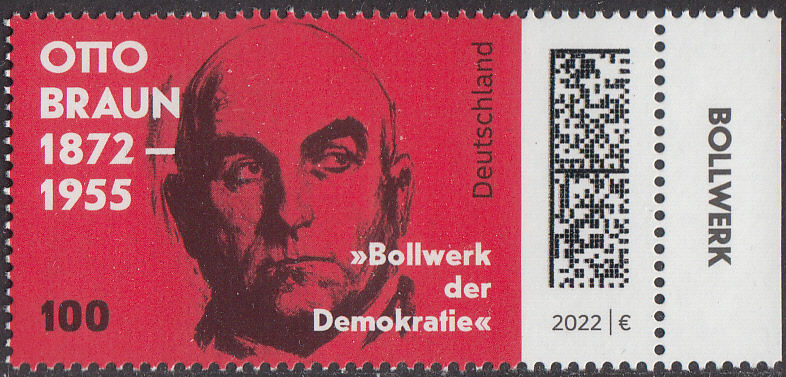
3. 150th Birthday of Otto Braun (Germany)
Otto Braun was a Social Democratic politician and Minister President of Prussia during the time of the Weimar Republic. He reorganised Prussia along democratic lines, thus turning it into the "Rampart of Democracy" in Weimar's turbulent years. In 1932 however he was ousted from power in the Prussian coup d'état (Preußenschlag) by Reich Chancellor Franz von Papen. I really like the design of this stamp resembling an old election poster and I am always happy to see stamps about the Weimar Republic.

2. Centenary of the Discovery of the Tomb of Tutankhamun (France)
I really like to see Egyptian antiquities. Actually I wanted to use the jubilee of Tutankhamun to dive deeper into Egyptian history, but other things prevented me from doing so. For some reason I am delaying it as much as the opening of the Grand Egyptian Museum. This French stamp is printed with gold foil. 


1. 450th anniversary of the Herzog August Library in Wolfenbüttel (Germany)
The Herzog August Library was founded by Duke Julius of Brunswick-Lüneburg in 1572. It houses a large collection of manuscripts of the Middle Ages and the Early Modern Period and is one of the oldest libraries in the World which have never suffered loss to its collection. Its most famous librarians were Gottfried Wilhelm Leibniz and Gotthold Ephraim Lessing. Today it is a major international research centre for Medieval and Early Modern culture. Some of its rooms are used as museum. Among the most important and famous manuscripts of the library are the Gospels of Henry the Lion, a copy of the Sachsenspiegel, a printed edition of the Latin Psalter with annotations by Martin Luther, Luther's German translation of the New Testament and parts of the Bibliotheca Corviniana Collection. The latter three are even part of the Memory of the World Programme of the UNESCO. How could I not put this wonderful stamp about a regional anniversary on the first spot for 2022?


Due to external circumstances my collection had to lie still for a big part of the year. Nonetheless I still get some amazing stamps, so after the nine issues of 2022 let's get right to the ten issues of 2023. 

10. Centenary of Bambi (Austria) 
Bambi is probably best (only?) known due to the 1942 Disney movie. However the young deer first appeared in a book by Felix Salten in 1922, which was used as the basis of the movie. On a sad note, the government of Nazi Germany banned the book in 1936 as "political allegory on the treatment of Jews in Europe." Many copies of the novel were burned.


9. Max Oppenheimer (Austria)
Max Oppenheimer was an Austrian artist, however this stamp is not on the list due to him. Way more I included it due to the depicted woman in the artwork: Tilla Durieux was an Austrian actress. She played a minor role in Fritz Lang's 1929 science fiction silent film Woman in the Moon, which played a role in my state examination this year.


8. Alphonse Mucha (France)
After the hard years of Covid-19 the museums are finally back on track. This year I hence visited some wonderful special exhibitions including Dürer in Berlin, Machine Room of the Gods and Renaissance in the North in Frankfurt am Main, Benin Bronzes in Hamburg, Otto the Great in Magdeburg, Venetian art in Munich, Barbarossa in Münster and Fischer von Erlach in Salzburg. One of favourites was Goddesses of Art Nouveau in Braunschweig. Of course also Mucha was thematised in the exhibition. 


7. Stralsund Letter (Germany)
One of the big jubilees of 2023 was the 175th anniversary of the Revolution of 1848. Once again however there was no stamp to honour an important event in Germany's  history. As some type of mockery or probably more due to historic ignorance this stamp about the Stralsund Letter was issued in the series Treasures of Philately. The stamps used on this historic piece show Frederick William IV of Prussia, the king who crushed the revolution. I just had to get this stamp together with a special postmark about the revolution. 


6. Wreck of a Hanseatic Ship (Estonia)
Following my post about the Hanseatic League I am always happy to have a new stamp. This one I bought during the IBRA in Essen. 


5. 400 years First Calculating Machine (Germany)
Wilhelm Schickard, a friend of Johannes Kepler, created the first Calculating Machine in 1623. The original one is long lost, but it was possible to reconstruct it due to an image in a letter sent by Schickard to Kepler. As a mathematician and historian this stamp was supposed to be higher on my list, but went down due to its ugly design. 


4. 100th Death Anniversary of Gustave Eiffel (France)
For the creator of its most famous landmark France issued this beautiful souvenir sheet. Not sure why, but I just like it.


3. 150th anniversary of the 1873 Vienna World's Fair (Austria)
The World's Fair in Vienna was just the fifth event of its kind and the first in the German-speaking World. It was held to commemorate the 25th throne jubilee of Emperor Franz Joseph and was a way to show the new confidence of the Austro-Hungarian Empire after the lost war against Prussia in 1866. It must have been a magnificient event to visit. 


2. Orient Express (France)
The Orient Express is a symbol of the elegant travelling by train and one of the great train journeys in the World. This souvenir sheet perfectly captures the spirit of the time. Regarding design aspects this might be in my opinion the most beautiful stamp issue of the year. 


1. 550th Birthday of Nicolaus Copernicus (Poland and Vatican)
Copernicus was one of the most influential persons in European history. Although he might not be the first to formulate such a model, he is connected with the heliocentric worldview, which places the sun in the centre of the universe rather than the Earth. The publication of the model in his book De revolutionibus orbium coelestium, just before his death in 1543, was a major event in the history of science, triggering the Copernican Revolution and making a pioneering contribution to the Scientific Revolution. A few countries issued stamps for his jubilee, but my favourite is this joint souvenir sheet from Poland and the Vatican. 


So these have been my favourite history stamps of 2022 and 2023, which I have chosen not only due to artistic reasons, but mainly by looking at the themes which left an imprint on me during these years, two years which have been extremely exhausting. Luckily I hope that 2024 will be much calmer, so it is suitably to look forward to what comes next. 

One of the backbones of this blog have been the Big Jubilees, but for the fourth year in a row there seems to be no deserving theme. Looking at stamp programmes the 150th anniversary of the Universal Postal Union will be celebrated by many countries. I am however hesitant to consider it as the Big Jubilee. The themes I have chosen for myself for a deeper involvement are the 100th death anniversaries of Franz Kafka and Lenin, the 125th birthday of Erich Kästner and the 300th birthday of Immanuel Kant. Other interesting jubilees include the 150th anniversary of Impressionism, the 150th birthday of Winston Churchill, the 250th anniversary of the First Continental Congress and Benjamin Jesty's experiments of smallpox inoculations, the 250th birthday of Caspar David Friedrich, the 500th anniversary of the German Peasants' War and the 700th death anniversary of Marco Polo. Will I write blog posts about any of these themes? I hope so, but I doubt it. 

Wishing You all a Happy New Year that will hopefully be filled with learning and collecting!

Sunday, 24 May 2020

The Hanseatic League - Narratives and Local Perspectives

When I started this blog in July 2015, the second post I wrote was about the Hanseatic League. Since then however I had plans to rewrite or expand this post and although there were two interested Hanseatic jubilees in the last two years, 800 years Rostock in 2018 and 350 years last Hanseatic Day in 2019, it took me until this year's jubilee (see below) to do so. But first let's take a look at what I wrote nearly five years ago:
"The Hanseatic League existed between the 12th and the 17th century. First it was only a union of merchants, but since the 14th century it was organised by the cities itself. Since then also Hanseatic Days were held frequently. The Hanseatic League was not only an important factor in the development of the Northern European economy but also of its politics and culture. At its climax nearly 200 coastal and inland cities joined the league. In the 15th century the demise of the Hanseatic League began with the strengthening of the local sovereigns, the shift of trade route and the new competitors developing due to the discovery of America. In 1669 only the nine cities Braunschweig, Bremen, Cologne, Gdansk, Hamburg, Hildesheim, Lübeck, Osnabrück and Rostock came together for the last Hanseatic Day."
Although some things might me improved here, I actually still like what I wrote back then and do not intend to change anything, but instead I want now to focus a bit on historic narratives about the Hanseatic League and some perspectives from different cities. 

In Germany the Hanseatic League is usually rated as a positive aspect of history, but during the last 150 the reason for this has changed. From the 19th century up until the Nazis the Hanseatic League was regarded as a German entity or even precursor of the national state maintaining a powerful position in Northern Europa, which was for example added by fleet glory during the rule of Emperor William II or as carrier of the expansion of the German lebensraum in the East by the Nazis. After World War II that changed. In East Germany for example the Hanseatic League was now an example for the influence of the masses on the history, although even East German historians denied this view. In Scandinavia the view of the Hanseatic League was more negative, as it was regarded as an exploiter of the local people. This negativity however faded away and gave rise to a new narrative, which was also shared with West Germany. As such the Hanseatic League was now viewed as a precursor of a unified Europa. This change of view is nicely documented by a German-Swedish joint issue back in 2006 celebrating the 650th anniversary of the Hanseatic League of Cities and also German Chancellor Angela Merkel followed this narrative during a speech in 2015, during which she highlighted its role as "first big successful trade network in Europa" ("der erste große erfolgreiche Wirtschaftsverbund Europas"), long lifespan, transnational thinking and joint interests and also draws a continuity to the European Union and the central thought of strength through unity. As I actually like this narrative, I do not want to discuss it too much, but just two other thoughts show that this view is as fragile as any other. At first it has to be said, that there might be Hanseatic cities in Estonia, Iceland, Poland and so on, but they were only part of the Hanseatic League, because German merchants lived there, which makes them not really transnational. Also I want to quote one of my docents who once said in a seminary about the history of the Baltic states in the Middle Ages that the Hanseatic League was a "semi-criminal forwarding cartel bullying out other competitors." All of these narratives for sure have their true core and although it is not ideal I think everyone knows that in the end the loudest narrative will be prevalent.


So, if it is not easy to really examine what the Hanseatic League was in history as a whole it should be easier to take a look in its role in the history of its constitutent parts, the cities, right? This however brings up an interesting problem: There is no complete list of Hanseatic Cities and it probably never existed. Some cities were part of the league for centuries, while others were just short time members. For some the membership was an important part of the local identity and economic importance, while others had many different pillars. And also the membership in the Hanseatic League of New Time, founded in Zwolle in 1980, is not a good indicator, as it includes on request all cities that were once part of the original league. In theory this however means that some Hanseatic cities which never made a request are not part of it, while other cities which were short time members are now full members of the new league. Without claim to completeness below you can find nine cities and groups of cities which I chose to examine different aspects of Hanseatic history and identity.

The first four cities are Bergen in Norway, Bruges in Belgium, London in the United Kingdom and Veliky Novgorod in Russia. None of these cities was ever an actual Hanseatic city, but they played an important part in the Hanseatic history, as the were home to the major foreign trading posts of the league, the Kontore. Of these Kontore not much survived until today, as most of them were closed at some point in history and were later demolished. Only the Kontor in Bergen, known as Bryggen, survived and as a "reminder of the town's importance as part of the Hanseatic League's trading empire" it is even on the UNESCO World Heritage List.


The next city is Visby on the Swedish island of Gotland. Visby or actually Gotland as a whole was an important early step in the formation of the Hanseatic League, as this was one of the earliest stages and centres for the trade in the Baltic Sea. In the early days in the second half of the 13th century Visby was also on a good way to become the leader of the nascent league, but was neutralised by the later Queen. Just like the Bryggen also Visby is on the UNESCO World Heritage List. It is there described as "the best-preserved fortified commercial city in northern Europe" and the "main centre of the Hanseatic League in the Baltic from the 12th to the 14th century."


Stralsund and Wismar in the German State of Mecklenburg-Vorpommern are usually presented as a pair, as as such they are together on the UNESCO World Heritage List. Both were major trading centres of the Hanseatic League and also share the common fate of later becoming part of Sweden. As the UNESCO highlights, they also "contributed to the development of the characteristic building types and techniques of Brick Gothic in the Baltic region." After having visited Stralsund myself last year plus making a short stop in Wismar, I can say that the Brick Gothic architecture there is truely amazing. Highlights are the Town Hall of Stralsund and Stralsund's Saint Mary's Church, which was once even the tallest building in the World. Check out this post on my other blog to see the cards I bought during this trip including many cards of Brick Gothic buildings. Stralsund is also inseparably linked to the Treaty of Stralsund, which was signed on this day 650 years ago in 1370 and which marked the peak of power of the Hanseatic League. This treaty ended the war between the Hanseatic League and the Kingdom of Denmark and assured the league of free trade in the entire Baltic Sea resulting in a monopoly on Baltic fish trade. Also now the league had a right to veto against Danish throne candidates. Unfortunately there was not (yet?) any philatelic commemoration of this jubilee. No stamp, prepaid cover or card and not even a special postmark were available. Only the magazin "Postfrisch" of the Deutsche Post published an article about the treaty in its most recent issue called "Triumph der Kaufleute" (Triumph of the Merchants). The article begins with the question, "who thought that merchants might defeat a kingdom?" and ends with a statement on its historic importance, which however was not much mentioned in contemporary sources of the 14th century.


Tallinn, Estonia's capital, is yet another Hanseatic-themed UNESCO World Heritage Site. Also Tallinn is described by the UNESCO as a major centre of the Hanseatic League, whose "wealth is demonstrated by the opulence of the public buildings (the churches in particular) and the domestic architecture of the merchants' houses." In fact it was one of the centres for the Hanseatic trade with Russia. An interesting building in Tallinn is the Great Guild Hall, which got the European Heritage Label in 2013. The Panel Report says that the "Great Guild's history of interactions with the Hanseatic League reveals the intriguing story of European 'integration' in medieval times."

I am still looking for a card of the Great Guild Hall. If you can help me please comment below.


Latvia's capital Riga was also one of the key centres of the Hanseatic League in Eastern Europa and just like Tallinn it is also on the UNESCO World Heritage List, important for the inscription was however not only the Hanseatic past but also the fine collection of art nouveau buildings. Generally the UNESCO describes Riga as "living illustration of European history." The Three Brothers, characteristic dwelling houses found in Hanseatic towns in the Baltic Region, also got the European Heritage Label in 2019. The restoration in the 1950s is described in the Panel Report as "instrumental in building resistance to the destruction of Latvian culture during the Soviet occupation, and for sustaining the link with Europe and the value of freedom during this period." Riga's Hanseatic past is thus described as its link with Europa. In 2007 Latvia and Germany celebrated their common Hanseatic past with a joint issue about Riga, Stralsund and Wismar. The House of the Blackheads is depicted for Riga on these stamps. The ones for Stralsund and Wismar you can see above.

I am still looking for a card of the Three Brothers. If you can help me please comment below.


Another former Hanseatic city, which would like to be included on the UNESCO World Heritage List, is Gdansk in Poland. To reach this goal "Gdansk - Town of Memory and Freedom" is currently inscribed to the UNESCO World Heritage List. While the application also includes Hanseatic memory next to the Westerplatte and sites of the Solidarity Movement, the text on the website mentions the Hanseatic League itself only shortly. Although the Hanseatic identity is still expressed today, it seems to have been even stronger one hundred years ago. Back then during the Interwar Period Gdansk as Free City of Danzig was a semi-autonomous city-state separated from Germany and put into a binding customs union with Poland. To commemorate the proclamation of the state (15th November 1920) a series of stamps was issued on 31st January 1921, which showed the famous Hanseatic Kogge (wrongly depicted with three masts) and thus activated the city's Hanseatic past and with that back then also its German identity.

Unfortunately I do not own this stamp.
The image is from the Colnect catalogue.


In Germany the image of the Hanseatic city is mainly defined by Bremen and Hamburg. Both of them managed to maintain their independence as free cities until today and still proudly call themself officially "Hansestadt" (Hanseatic City). After the last Hanseatic Day in 1669 it were these two cities plus the Queen who were responsible for the Hanseatic legacy and managed and later sold the Kontore. Their inhabitants and with them all Hanseaten are usually described as cosmopolitan, urban, sober, reliable and stiff. After the German Reunification also other cities were allowed to officially call themself Hansestadt and more in East and West followed since then. Main reasons for this decision was not only a link to history and Europa but also a good touristic marketing. Beside Stralsund and Wismar the earliest were Greifswald and Rostock, which celebrated its 800th anniversary in 2018 and was thus chosen as location for a Hanseatic Day of New Time. In total there are now at least 27 official Hansestädte.


Special Postmark about the Hanseatic Day of New Time in
Rostock in 2018 with a stamp about Rostock's 800th anniversary

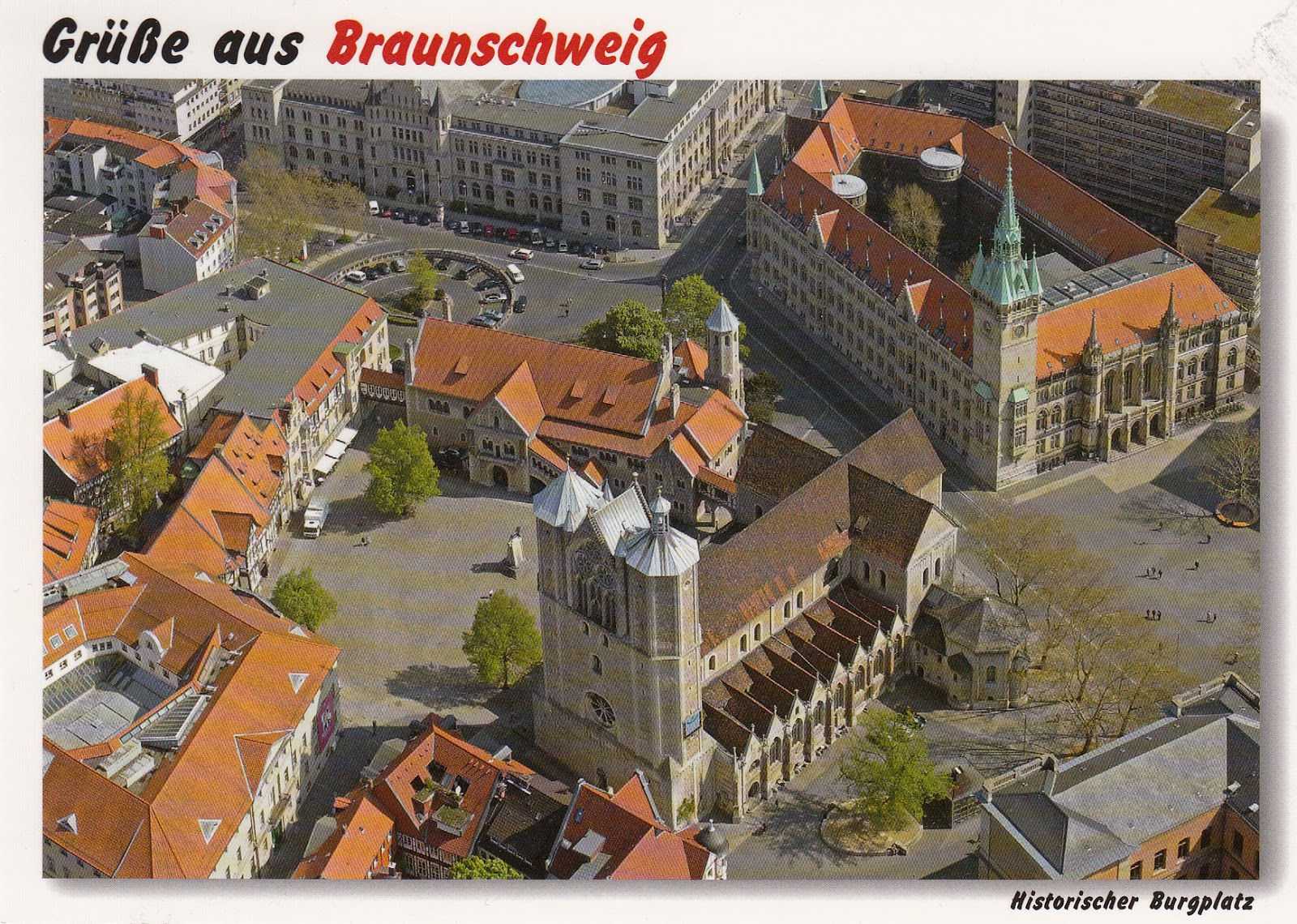
These were more or less the cities with the highest identity-establishing connection with the Hanseatic League, who decided to put their Hanseatic past on the UNESCO World Heritage List or still proudly present themself as Hansestadt, but keeping in mind that there were around 200 Hanseatic cities you can see that there are nearly 170 left without such a connection. These include formerly important members of the league like Braunschweig, Dortmund and Cologne, two more of the last nine (Hildesheim and Osnabrück) and so many more little and big cities. As my own home town Braunschweig is among these cities, I can say from my own experience that not much is left of a Hanseatic identity, although the fifth Hanseatic Day of New Time was hosted here in 1985 and will be again hosted in 2027 (I was not even born in 1985, but I look forward to the next one.). A reason for that might be that other aspects are more important for our historical awareness here, but also that actually nothing of Hanseatic architecture can be seen here and unlike in other cities like Stralsund or Wismar the Hanseatic League is so not so present in the cityscape. In fact the only Brick Gothic building is the Liberei, a small and well hidden library building from the 15th century, of which for example I have never seen a postcard. I would have really liked to tell you how the Hanseatic League is presented in our city museum, but unfortunately that branch is still closed due to Covid-19. I might add that later. I am sure other cities have similar experiences. If you are from a former Hanseatic city it would be great if you would post your experience in a comment.


But wait, one city is still missing: the afore-mentioned Queen, Lübeck. Here the Hanseatic identity is still alive. It quite natural officially holds the title Hansestadt and is since 1987 on the UNESCO World Heritage List. Its historic importance comes not only from its role as Queen of the Hanseatic League, but also because its town rights known as Lübeck Law and the Brick Gothic spread from here across Northern Europa. Of enormous architectural significance is especially the Saint Mary's Church, as it is considered to be the mother church of the Brick Gothic. The Town Hall on the other site was once the meeting place for the Hanseatic Days and inspired other town halls in the Baltic area. Since 2015 Lübeck is also home to the European Hanseatic Museum, the World's largest museum about the history of the Hanseatic League. During the opening of the museum Angela Merkel also hold the speech I quoted at the beginning. I already dealed with Lübeck's history in the old post linked at the top, so check that one out if you want to know more. Also if you ever are in Lübeck visit the European Hanseatic Museum. It is one of the best museums I ever visited and I can really recommend it.


Actually I planned to devote more time to the creation of this post, but now honestly I spent more or less just a day writing it. Sources were Wikipedia, the website of the UNESCO, the Panel Reports of the European Heritage Label from 2013 and 2019, the Postfrisch Ausgabe 3/2020, some older posts from this blog and my other and the speech of Angela Merkel from 2013, which you can find here (in German only). Also I began reading Rolf Hammel-Kiesow: Die Hanse, Munich2 2002 and used it for this post, but so far did not finished it, so I might change some things when/if I finish it.

Sunday, 17 July 2016

The University of rich Estonians (Estonia)

The University of Tartu was founded by King Gustav II Adolf of Sweden in 1632, short after the occupation of the city by Sweden, and is thus Estonia's oldest university. It closed down in 1710 after the city became a part of Russia, but was refounded in 1802. It became the university of the Estonian nobility and intellectual bourgeoisie and the doctors and public servants, who were educated there, were active in the entire Russian Empire.

Today it is the national university of Estonia and the only full-scale university in the country. The Historic Ensemble of the University of Tartu got the European Heritage Label in 2015.