
Fighting for the Revolution his tactical skill soon became apparent. Three years after the stamp above two campaigns in Napoleon's early career were shown on French stamps, the Battle of Arcole during the Italian Campaign and the Egyptian Expedition. Napoleon went to Italy shortly after his marriage with Joséphine de Beauharnais in 1796. He quickly defeated the Austrian ally Piedmont and became involved in the Siege of the Austrian garrison in Mantua. The Battle of Arcole was part of an Austrian attempt to lift the siege, which however failed, and the overall campaign resulted in the Treaty of Campo Formio granting France the rule over Northern Italy and the Low Countries, which were subsequently exploited by Napoleon and his troops. During this period his influence in France increased. Plans for an invasion of Great Britain followed, but Napoleon decided that the French marine was not strong enough and so decided that at first Egypt should be captured to hamper Britain's access to India. This Egyptian Expedition began with the capture of Malta, but at the end resulted in a French catastrophe. After Horatio Nelson destroyed or captured most of the French fleet, Napoleon went on some brutal attacks on the Ottoman cities of Arish, Gaza, Jaffa and Haifa and ultimately fled back to Paris in August 1799. The focus of this second stamp is however not the French defeat, but the scientific dimension of the expedition. More than 150 scientists joined Napoleon and their discoveries included after all the Rosetta Stone, which Jean-François Champollion later used to decipher the hieroglyphs.


The following events in Napoleon's life and career are ignored on French stamps. The next event to be honoured is the preparation of the Code Civil. The Code Civil or Code Napoleon entered into force in March 1804. This collection of written laws was a important step in the defeudalistion of Europa and is still used in France to this day. Even in parts of Germany it survived the end of Napoleon's rule and was in use until the end of the 19th century. Shown on the stamp are the Conseil d'État, Napoleon and Jean-Étienne-Marie Portalis. Portalis drew up the Code Civil together with François Denis Tronchet, Félix-Julien-Jean Bigot de Préameneu and Jacques de Maleville, but also worked on the Concordat of 1801 and later became a member of the government as Minister of Public Worship. Another stamp about the Code Civil was issued in 2004. Also there are two stamps about the creation of the Légion d'honneur in 1802 (1954 and 2002), which falls in the same period but which I unfortunately do not have.

On 2nd December 1804 Napoleon was coronated Emperor at the Notre Dame de Paris in the presence of Pope Pius VII. During the ceremony a golden laurel wreath recalling the Roman Empire and a replica of Charlemagne's crown were used. Napoleon had the laurel wreath on his head and crowned his wife with the replica. The stamp shows a detail of the painting The Coronation of Napoleon by Jacques-Louis David. It was created as official depiction of the event and is now kept in the Louvre. As France decided not to thematise anything that happened before the coronation, I guess it is fair to do the same.

Last year this stamp about La Roche-sur-Yon was issued. The city had been destroyed during the Vendée Revolt and was rebuilt had the behest of Napoleon. In May 1804 it officially became the seat of the Vendée. At this time it was called Napoléon-sur-Yon. Shown on the stamp is the statue of Napoleon that was erected in 1854.

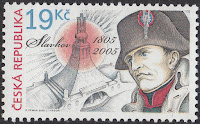
Today the first French Emperor is naturally known as Napoleon, but did you know that this was not always the case? During his early career the man was known as Bonaparte or even earlier as Buonaparte. It was just when he became Emperor that the given name became synonymous with the ruler and as such he went out to gain his biggest victory at the Battle of the Three Emperors near the small Austrian/Czech town of Austerlitz (Slavkov u Brna) on the first anniversary of his coronation. Known as tactical masterpiece, Napoleon defeated the outnumbering armies of Austria and Russia. After this battle Napoleon was definitely the hegemon of Continental Europa. For the 200th anniversary of the battle France jointly issued this stamp with the Czech Republic. As you have seen so far this is one of the very few Napoleonic battles that was honoured with a French stamp, which makes this one a bit outstanding. Probably they have chosen the battle, because it was his biggest victory, but on the other hand maybe the idea for this joint issue came from the Czech Republic, which however later issued stamps about Napoleon's big defeat in Leipzig. A gorgeous, but mysterious issue! Apropos, the monument on the stamps is the Cairn of Peace Monument in Prace.

After his victory in Austerlitz installed friends and family as rulers in various European states. The only one of them who was shown on a French stamp was Joachim Murat. Murat was a military commander and married Napoleon's younger sister Caroline in 1800. He became Grand Duke of Berg (1806-1808) and King of Naples (1808-1815). The stamp however only calls him Roi de Naples, his earlier title in the small artificially created grand duchy in Germany is ignored. After the Battle of Leipzig he switched sides to save his throne, but switched back after Napoleon's return from Elba in 1815 and was killed in the end by the forces of the rightful King Ferdinand IV of Naples.

From Austerlitz and Joachim Murat we jump in time straight to 1815. You might remember that there was some sort of battle this year and you remember right. Who does not know the Battle of Huningue? Huningue is a small Alsatian town right at the border between France, Germany and Switzerland and is more or less a suburb of Basel. Due to its location the Sun King Louis XIV instructed Vauban to built a fortress there. The fortress was first besieged by the Austrians in 1796/97, later by the Bavarians in 1813/14 and once again by the Austrians in 1815. When the new French government demanded a ceasefire after Napoleon's abdication, the commander decided to bombard Basel instead. Ultimately however the fortress surrendered.

The first French stamp about Napoleon was issued in 1951 and now 70 years later his death is acknowledged with a stunning souvenir sheet. In my opinion this is one of the most visually appealing stamp issues of the year. You really need to seek it out to see it in real life. A scan can not do it justice. It is printed in a combination of offset and intaglio printing and much gold foil is applied. Of special interest are those small bees recalling artifacts from the grave of the Frankish king Childeric I from the Merovingian dynasty, as Napoleon wanted a royal symbol that has a historic model without being connected to the Ancien Régime. The pomp of this issue however can not disguise Napoleon's fate. Beaten he was sent to exile on the island of Saint Helena. There he could either watch the sea as shown on the lower stamp or play with the rats as was often shown on contemporary caricatures. There on a remote island in the South Atlantic Ocean one of the most famous and influential men in European history died on 5th May 1821.

After all those French stamps it is time to add the narrative of the First Emperor of France with some stamps from other European countries. Let's get one thing out of the way, not all of them are as flattering as this Monégasque stamp issued for Napoleon's Birth Bicentenary in 1969.

Adding the stamps in the chronological order of the depicted events the first I have is however another victory, the Battle of Marengo. This battle was part of the War of the Second Coalition and was fought near the city of Alessandria in Northern Italy in June 1800. After all the Battle of Arcole and the Treaty of Campo Formio had not ended the Austrian involvement in Italy. Barely four years later they had to be driven out again. This battle also consolidated Napoleon's rule as First Consul. It has to be mentioned that this battle has also appeared on a French stamp. In 1968 there was a stamp about General Desaix, the French commander during the battle, which also shows a scene of the battle. Unfortunately I became aware of it too late to add it to my collection.

Leaving Europa for a stamp, the rule of Napoleon had also an influence on the USA. In 1803 Napoleon sold the French colony of Louisiana or more precisely for most of the area the right to obtain it. Napoleon actually planned to re-establish the French rule in the territory, but after some failures decided to sell it instead. This Louisiane Purchase nearly doubled the size of the USA. Shown on this US stamp are not only the US negotiators, but also French Treasury Minister François Barbé-Marbois. After this sesquicentennial issue from 1953 a bicentennial stamp was also issued in 2003.

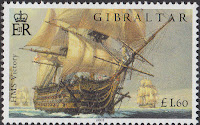
Everyone who has ever been to London probably knows Trafalgar Square and the Nelson's Column there, but many maybe do not know what Trafalgar was. Or was that just me when I was in London in 2011? The Battle of Trafalgar was a naval battle in the War of the Third Coalition in October 1805. Napoleon had the idea to conquer Great Britain and to accomplish that plan the French and Spanish navies were combined to take control of the English Channel. The fleet however was met off Cape Trafalgar on the southwest coast of Spain by the British navy under the command of Admiral Lord Horatio Nelson and Nelson was against all odds victorious, although loosing his own life. The battle became a focal point in the history of British naval supremacy in the 19th century. As such it was already honoured on many stamps. I think for the Bicentenary in 2005 not only the United Kingdom itself, but also all overseas territories and crown dependencies issued stamps, which in the usual British tradition are not just single stamps, but always bigger sets. In my collection I have this set from Gibraltar issued on 31st January 2005. Actual timber from the original HMS Victory, Nelson's ship during the battle, is affixed to the £1.60 stamp and similar stamps have been issued in Ascension Island, the Bahamas, Bermuda, the British Indian Ocean Territory, Cayman Islands, Jamaica, Kiribati, Naura, Saint Helena, Saint Lucia and Tristan da Cunha.



As philatelist you probably know that there are French and Spanish stamps issued for Andorra. The reason is that this small country is actually headed by two co-princes, one from France and one from Spain. The turbulent years of the French Revolution however brought change on the French side and in 1806 Napoleon restored the status quo ante. I could not find much about what this means in detail, but it was enough for this Bicentenary issue in 2006 by the French Post in Andorra.

About the Napoleonic era on the Iberian Peninsula I know very little, as it is never the focus for German depictions of the time. For my collection I got this Portuguese set about the Bicentenary of the Peninsular War issued in 2010, so I will focus on that period and ignore the background. Well, Portugal was that time still an ally of the United Kingdom and had no interest in joining the Continental System (the German word Kontinentalsperre or the French blocus continental somehow sound nicer). To change that Napoleon decided to attack Portugal and invade Spain on the way. That was in 1807. It is however also said that Napoleon's real motive might have been to dethrone the Spanish King to replace him with one of his brothers. The result was a big political mess and a military catastrophe, as the Spaniards did not like to be conquered and began a bloody guerrilla uprising that binded French forces which should been used in other theaters. Portugal and Spain were later supported by the United Kingdom. Shown on these stamps are the battles of Vimeiro (1808), Bussaco (1810), Grijó (1809) and Pombal (1811). In 1928 there had already been a set about the Battle of Rolica (1808). The fightings on the peninsula had actually World-historical dimension, as it enabled the independence of the South American colonies of both countries.


Inspired and scared by the events in Spain, Austria began to fear a similar fate for its monarchy and also hope for uprisings in the German territories. To help in both cases armaments and reforms were started. Napoleon thought that Austria would not do anything without allies and thus not acted at all. Austria however feared that Napoleon just waited for an ending of the fightings in Spain to do the same with the Austrian monarchy and became active with an attack on the French ally Bavaria. After some small battles Austria was defeated in Eckmühl near Regensburg in April 1809 and Vienna was captured three weeks later. Another week later the Austrians however defeated Napoleon in the Battle of Aspern and Essling (21st/22nd May 1809), before being defeated again by Napoleon in the Battle of Wagram (5th/6th July 1809). The Austrian fate was not as bad as that of Prussia or Spain, but the consequences of this hubris were not good either. Although Austria mainly fought alone, these fightings are known as War of the Fifth Coalition, as they were theoretically backed by Sardinia, Sicily and the United Kingdom. Good to see the ultimately pointless victory in Aspern and Essling on an Austrian souvenir sheet.

Not all Austrian hopes for uprisings were baseless. In Tyrol the innkeeper Andreas Hofer started in the context of the War of the Fifth Coalition in April 1809 a rebellion against the Bavarian occupiers, who controlled the territory by Napoleon's grace since 1805. The rebellion failed, but Hofer is to this day celebrated as a Tyrolean national hero. His remains are buried in the Hofkirche in Innsbruck next to the cenotaph of Emperor Maximilian I and I know of at least three Austrian stamps about Hofer including this souvenir sheet as most recent one. As consequence of the rebellion Bavaria had to cede parts of Tyrol to direct French control.

From the events in Austria we jump straight to Russia. Checking the timetable in the small monography by Johannes Willms I had read about Napoleon this seems to be justified, as he also does not include any events between 1809 and 1812. Russia was at this time the probably most independent European great power. The relations with Napoleon had been for a while amicably and on eye level. When the Russian Emperor however decided in December 1810 to leave the Continental System, which had more disadvantages than advantages for Russia, the conflicts began anew. In June 1812 Napoleon began his Campagne de Russie. He thought that the war would be over the faster the more troops he would send there, but in the end this idea just meant that more soldiers died in the harsh Russian winter. This Soviet souvenir sheet honours the 175th anniversary of the bloody Battle of Borodino, which ended with a French victory used to capture Moscow where Napoleon waited too long. The invasion ended in a desaster, but Napoleon was not yet defeated. The other European states however hesitated to seize the moment.

The governments might have hesitated, but in the population it began to seethe. Especially in Prussia the people demanded to join the fight and the king had to grant their wish. Together Prussia and Russia were now fighting against Napoleon, but after some French victories, Austria negotiated a ceasefire between the three and afterwards Austria, Prussia and Russia signed a modest proposal which would have saved Napoleon's rule in France and big parts of Europa against the loss of former territories of the three powers and some of their allies. Napoleon denied and the for the being final war began. He soon lost the big Battle of the Nations at Leipzig, his Confederation of the Rhine crumbled, the allies were on their way to a war-weary France and due to his hubris Napoleon was eventually dethroned and send to Elba. This War of the Sixth Coalition is in Germany usually known as Befreiungskrieg(e) (War(s) of Liberation) and is connected with an idea of national identity. Although they played a big part in the conception of a united German history, they were rarely featured on German stamps. A Berlin stamp showed the Prussian National Monument for the Liberation Wars, the "anti-imperialist" German Democratic Republic (East Germany) showed some nice Prussian militaries on a set for the 150th anniversary and here in West Germany only the participants Blücher (shown below), Clausewitz, Körner and Stein were shown on some incoherent stamps. For the Bicentenary of the Battle of Leipzig the Czech Republic and Russia issued souvenir sheets, but here in Germany only a stamp for the Centenary of the Monument to the Battle of the Nations was issued. The focus is thus not the victory over France, but the technical feat of constructing Germany's biggest monument.


Napoleon might have been defeated and in exile, but it was not long until he returned. He quickly gathered an army and created a new rule which soon ended with the War of the Seventh Coalition and the Battle of Waterloo. This battle in modern day Belgium is unlike the Battle of Huningue probably one of the most famous battles in European history. It occured while the European powers were already discussing the political future of the continent in Vienna and led to Napoleon's final exile on Saint Helena. For the Bicentenary Belgium issued a stunnng souvenir sheet with five stamps about leaders during the battle. I have those two about Napoleon (on a Waterloo card) and the Prince of Orange and the other three are Blücher, Ney and Wellington. The Isle of Man and the United Kingdom also issued some stamps and in Germany we got a special postmark.


I had written about it earlier this year and will hopefully do so again soon, but unlike the last years 2021 does not have one big jubilee. The Death Bicentenary is however a jubilee that spawned at least a resonable number of stamps. Beside the obligatory catch penny issues to my knowledge there were only stamps from Andorra (French Post), Italy, Malta and Saint Helena. In my collection I only have the one from Italy. It shows a detail of Andrea Appiani's painting Ritratto di Napoleone (1805) and includes the opening phrase of Alessandro Manzoni's ode Il cinque maggio (1821) written in response to the news of Napoleon's death, Ei fu (He was). Unlike the French sheet this stamp was issued on Napoleon's actual death day the 5th May.

- From France I have already mentioned the stamps about the Battle of Marengo and the Légion d'honneur. In 2004 there was also a very interesting set showing Napoleonic soldiers and the Emperor himself as some sort of small toy figures
- The Free State of Danzig in the Interwar Period issued a stamp about the city's return to Prussia in 1814 in a set about historic events.
- From Germany I have already mentioned the stamps about Clausewitz, Körner and Stein. Of interest might be also a stamp about Prussian Queen Louise of Mecklenburg-Strelitz who met Napoleon in Tilsit in 1807.
- As part of sets about the Battle of Trafalgar Gibraltar and the Isle of Man also included stamps about the Battle of the Nile, the latter also included the Battle of Copenhagen.
- During the Napoleonic era the French colony Haiti became independent and of course there are some stamps of that event from the country.
- For the Bicentenary of the French Revolution Italy issued a stamp showing a Bicorne, the hat famously worn by Napoleon. In 2014 there was a stamp about the New City of Bari, which was constructed at the behest of Joachim Murat.
- Malta issued a set of four about the Bicentenary of Napoleon's French capture in 1998. One of the stamps shows Napoleon himself.
- Apart from the stamp above Monaco issued some more stamps about the Emperor. A set of four about the Bicentenary of his Coronation also includes a stamp about his wife Stéphanie de Beauharnais. In 2011 for some reason even a stamp about the Bicentenary of the Birth of his son Napoleon II was issued.
- With the grace of Napoleon Poland was reborn as (semi-)independent state after it was divided between Austria, Prussia and Russia at the end of the 18th century. As I have learned too late, there are a few Polish stamps about this time of the Duchy of Warsaw.
- In 2002 Russia issued a set about Emperor Alexander I. One of them shows him entering Paris after Napoleon was defeated.
- Saint Helena of course issued many stamps about its most famous inhabitant. The most interesting in my opinion is the souvenir sheet issued for the Bicentenary of Napoleon's Arrival in 2016. Unfortunately I was not able to get it.
- Napoleon liked San Marino and offered the state an enlargement at the cost of its neighbours. The offer was denied, but nonetheless was honoured with stamps.
- The Czech Republic issued a stamp for the Battle of Austerlitz and Slovakia followed with a stamp for the Peace of Pressburg/Bratislava signed as result of the Austrian defeat. The stamp shows a small portrait of Napoleon and the Primate's Palace in Bratislava where the treaty was signed.
- As I have written above, my knowledge of the Napoleonic era on the Iberian Peninsula is rudimentary and due to that I was not sure which Spanish events and stamps I had to include. I know now however that there are at least stamps about Agustina de Aragón, artworks by Francisco Goya, the Spanish flagship during the Battle of Trafalgar and the Constitution of 1812. In a series about Spanish history in caricatures issued in 2002 there is also one stamp about Napoleon.
- As I had mentioned before, it would be nice to see a bit more of Napoleon's early life and way to power on stamps. Things and events I might imagine are the military academy at Brienne, the École Militaire in Paris, the Siege of Toulon and Napoleon together with the other Consuls.
- The War of the Fourth Coalition is not honoured on any European stamp. This war followed the creation of the Confederation of the Rhine and saw the Prussian defeat at Jena and Auerstedt, the Russian defeats in Eylau and Friedland and the Treaties of Tilsit. For the Bicentenary of the Battle of Jena and Auerstedt there were two special postmarks used in Jena and Auerstedt respectively, but so far I have never seen them for sale anywhere. There were however some catch penny issues about the battle from territories like Chad, Congo, Equatorial Guinea and Sharjah.
- Above I have already mentioned the Battle of Wagram from the War of the Fifth Coalition. That one was also never shown on a European stamp (there is however a rather nice one from Ascension Island). Generally I would have wished that all the big Napoleonic victories had got the "Austerlitz treatment" for their Bicentenaries.
- Additionally it would be nice as well to see more relatives of Napoleon on French stamps like the one about Joachim Murat. Those might include King Joseph of Spain, Grand Duchess Elisa of Tuscany, King Louis of Holland, King Jérôme of Westphalia, Eugène de Beauharnais, Napoleon II and his wives Joséphine de Beauharnais (shown on a stamp from Monaco) and Marie Louise of Austria.
- I am not aware that there were any stamps about the Napoleonic time in Belgium (apart from Waterloo), Denmark, Central Italy, the Netherlands, Sweden or Switzerland. Generally a stamp about the map of the Napoleonic Empire would be very interesting.
- No stamp has ever shown Napoleon on Elba. Stamps about the Villa Mulini and the Villa San Martino would be nice.


